Scenes now have a calendar: browse the catalog by the month it dropped
The scenes list answered what we index and stayed silent on when. The release dates were in the data and had no surface, so we added one. /calendar/ is a year to month to scenes cascade: 22 year cards each with a sparkline of their own months, a month row where every tile carries the real release count and a fill bar, and the scenes themselves underneath, opened in the same popup the rest of the site uses. The whole page rides on the index /scenes/ already loads, bucketed by year and month in the browser, so there's no new query, no second copy of data, and none of it loads anywhere except the calendar page itself. The header reads 38,051 dated scenes across 2005 to 2026, and that's indexed, dated content only, not every scene a studio ever shipped.
Until this week the only way to look at our scene catalog was /scenes/, a flat grid with a search box and three dropdowns. It answers what well enough, filter by site, sort by rating, type a name. It says nothing about when. You could not stand back and see that the studios we index pushed out 364 scenes in January 2023 and barely a tenth of that per month back in 2006. The time axis was sitting right there in the data and we had no surface for it.
So we built one. /calendar/ is a release calendar: pick a year, pick a month, see the scenes that dropped. Three steps, top to bottom, no page reload between them.
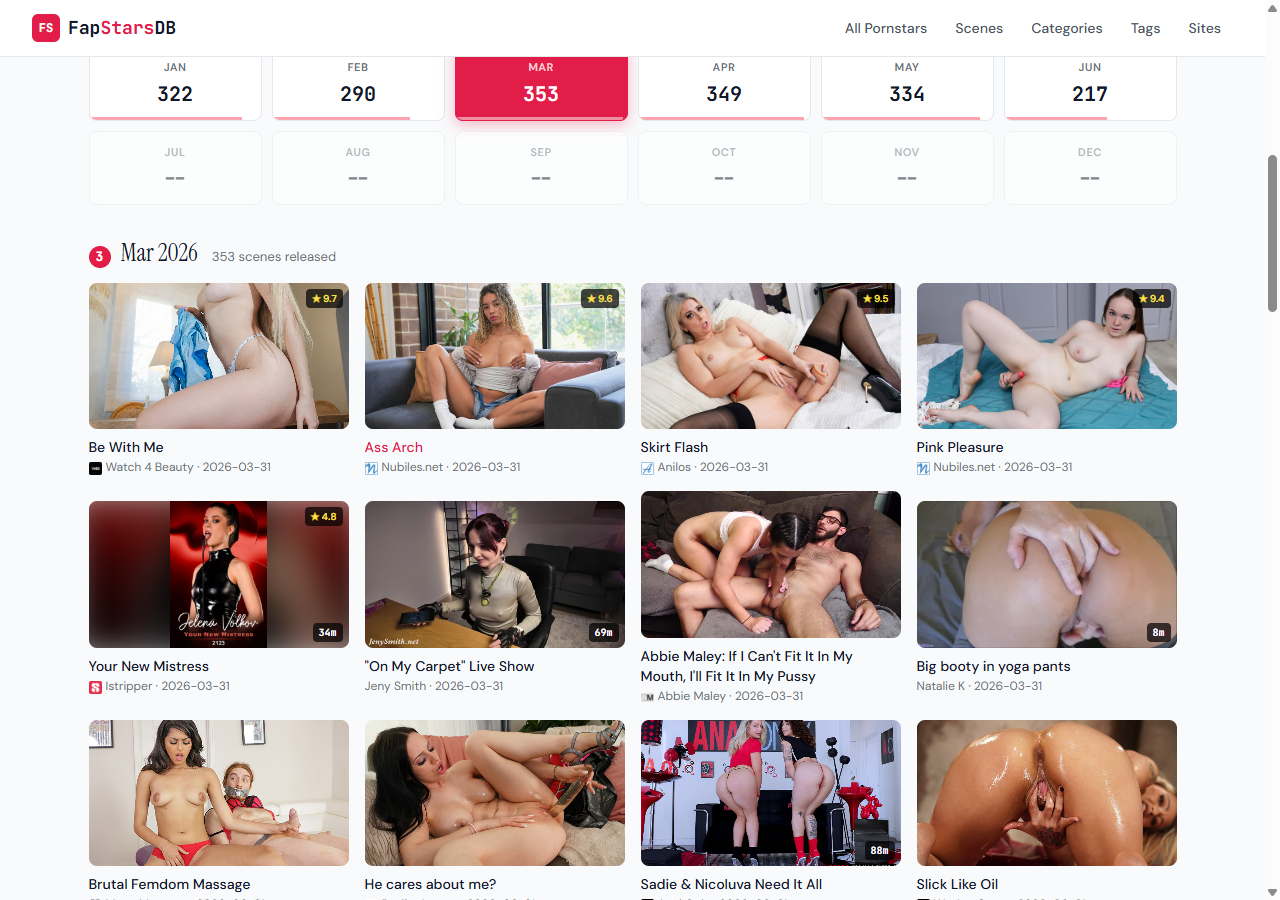
What it actually shows
The year row is 22 cards, 2005 through today, each with a little twelve-bar sparkline of its own months so the shape of the year reads at a glance. The ramp from 2016 to 2019 is obvious once you see it drawn out. Click a year and its months unfold below, each tile carrying the real release count and a fill bar scaled against the busiest month we have on record. The fullest single month in the whole catalog is January 2023 at 364 scenes; the leanest populated one is August 2005 with six. Click a month and the scenes load underneath as normal cards. Click a card and you get the same scene popup that lives everywhere else on the site, with the studio link, the performers, the tags, and the watch button.
None of that popup is new, by the way. It is the exact same scene-modal the performer pages and /scenes/ already use, opened by the same js-scene-card buttons carrying the same data-scene-* attributes. The modal that every page already loads just picks them up. Nothing about the click is special to the calendar.
Why it cost almost nothing to build
The whole page runs on a file that already existed. /scenes/ loads a compact index of every indexed scene, one row each with its title, studio, release date, thumbnail, rating, performers and tags. The calendar loads that same index, buckets the rows by year and month in the browser, and counts them. The cascade is just three views over one array. No new database query, no new build step, no second copy of the data to keep in sync. If a scene shows up on /scenes/, it shows up in the calendar, because it is literally the same list read a different way.
It also stays off every other page. The script and that index only load when you open /calendar/ itself, so the rest of the site carries none of the weight.
What the numbers do and do not mean
The header says 38,051 scenes across 22 years. Read that as scenes in our catalog that carry a release date and a thumbnail we can show, not every scene every studio ever published. Roughly fourteen hundred scenes we hold have no usable release date, so they simply do not appear here; a calendar with nowhere to file them would be lying about where they go. And the count only reflects sites we have actually indexed. A busy month in 2024 looks busy because of the studios we track, not because we surveyed the industry.
Two edges are ragged on purpose. 2005 starts in August because that is the earliest dated release we hold, and 2026 runs only as far as the catalog does right now, so its later months are thin or empty rather than zero-because-nothing-happened. The month tiles for months we have nothing for are greyed and not clickable, which felt more honest than rendering a confident 0.
The link sits in the footer under Browse, next to Scenes. If you want to feel the back half of the catalog, open 2008 and walk forward a year at a time; the sparklines fill in front of you.